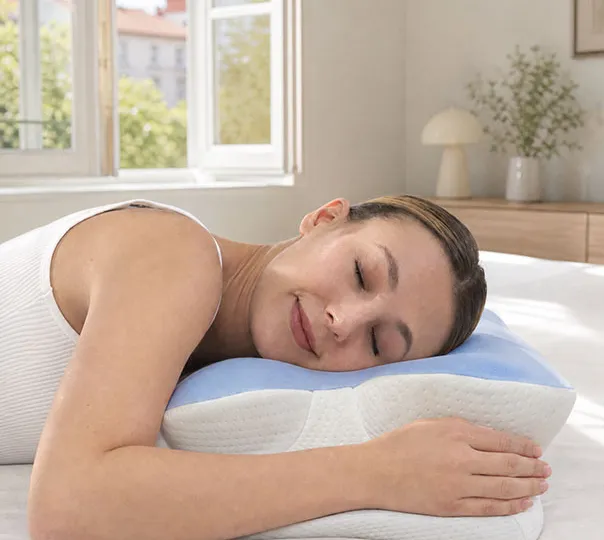
If you’re wondering why you snore, or whether a different pillow could help, sleep posture is one of the more common — and more fixable — pieces of the puzzle. Here’s how position affects snoring in plain language, and when it’s actually a sign to see a doctor instead of buying a new pillow.
The basic mechanism
Snoring happens when air has to squeeze through a narrowed airway in the back of the throat, making the surrounding soft tissue vibrate. Several things can narrow that airway, and sleep posture is one of the more common and most fixable ones: lying on your back lets gravity pull the tongue and soft palate backward, which can partially block the airway — Sleep Foundation notes this is “possibly due to gravity” relaxing airway tissue. Sleeping on your side generally keeps the airway more open for most people, which is why side-sleeping is a commonly suggested first step for occasional, posture-related snoring.
Does sleep position affect more than just snoring?
Yes — posture is tied to overall sleep quality, not only snoring. A 2022 sensor-based sleep study published in the peer-reviewed journal Sensors tracked 13 people over 15 nights and found that right-side sleeping was associated with the best sleep quality (fewer nighttime awakenings, more slow-wave — the deep, restorative — sleep), left-side sleeping came second, and back-sleeping scored worst on both fronts. The same study found that people who turned position more often during the night tended to have worse sleep quality overall, not better — restless turning is a symptom of poor sleep, not a fix for it.
Where your pillow fits in
A worn-out or poorly-matched pillow can make this worse indirectly, by encouraging a head/neck position that narrows the airway further — for example, a pillow that’s too flat lets the head tilt back, and a pillow that’s too high pushes the chin toward the chest. Either extreme can affect breathing. An ergonomic pillow aims to keep the head and neck in a more neutral position, which may help with mild, posture-related snoring for some people — but a pillow changes posture, not the underlying anatomy, so it won’t help every cause of snoring.
What a pillow can’t fix
Snoring has several possible causes that a pillow has no effect on, including nasal congestion/allergies, alcohol use before bed, being overweight, anatomical factors (like a deviated septum or enlarged tonsils), and obstructive sleep apnea. This matters because some of those need a different kind of solution entirely, and one of them — sleep apnea — needs medical attention, not a better pillow.
When to see a doctor instead of buying a new pillow
Talk to a doctor if snoring is loud and happens most nights, and especially if it comes with any of the following: pauses in breathing during sleep (often noticed by a partner), gasping or choking awake, excessive daytime sleepiness even after a full night’s sleep, or morning headaches. These can be signs of obstructive sleep apnea, which is a real medical condition that needs proper diagnosis (often a sleep study) and treatment — not something any pillow, including the ones reviewed on this site, is designed or claimed to treat.
The takeaway
If your snoring is mild, occasional, and seems tied to sleeping on your back with a pillow that doesn’t support a neutral neck position, posture and pillow changes are a reasonable, low-risk first thing to try. If it’s loud, frequent, or comes with any of the warning signs above, see a healthcare professional before spending money on a pillow marketed to help with snoring.
Sources: Sleep Foundation — Sleep Posture; Zhang et al., “The Relationship between Sleeping Position and Sleep Quality: A Flexible Sensor-Based Study,” Sensors 22, no. 16 (2022): 6220, pmc.ncbi.nlm.nih.gov/articles/PMC9416198.
Also read our full review:
Melara Max Pillow Review 2026: Who This Butterfly Pillow Fits (and Who It Doesn't)
Affiliate disclosure
This content contains affiliate links. If you buy through one of these links, we may earn a commission from the company selling the product, at no extra cost to you. This commercial relationship never influences our editorial review — see our methodology.
Also read our health disclaimer and the full affiliate disclosure page.